11 Small Apartment Desk Setup Ideas That Don't Need More Floor Space
Eleven ways to build a working desk setup in a small apartment — vertical storage, a wall-mounted monitor arm, a desk that doubles as a dining table, and a wallpaper that stands in for the view you don't have.
Most desk setup advice quietly assumes a spare room. In a studio or a one-bedroom, the desk is in the same room you sleep, eat, and relax in, and every improvement has to earn its floor area. These eleven ideas are ordered by how little space they take: the first few cost nothing and take no floor at all, the later ones need a drill or a delivery.
Short version: in a small apartment, buy vertical, not horizontal. A monitor arm frees roughly 30 × 25 cm of desk surface for about $30. A wall shelf above the desk adds storage without a footprint. And because you can't add a window, the cheapest way to make the room feel less closed in is to put motion on the screen you already stare at — a live wallpaper with a real outdoor scene costs nothing in floor space.
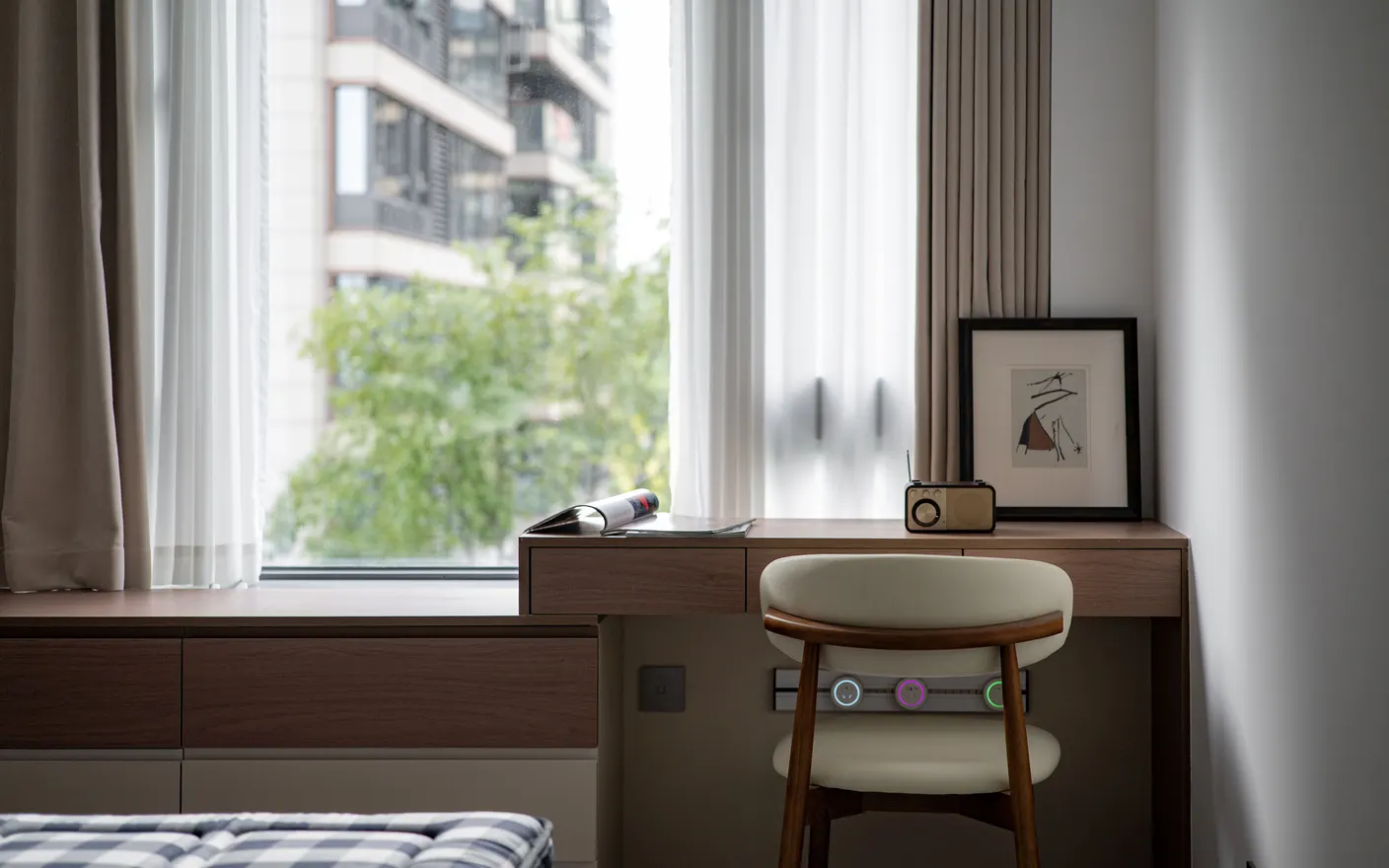
1. Put the monitor on an arm — reclaim the 30 cm the stand is eating
A standard monitor stand occupies roughly 30 × 25 cm of the deepest, most usable part of the desk. A clamp-on arm moves that weight to the back edge and gives the space back — enough for a notebook, or for pushing the keyboard back when you eat there. Basic arms start around $25–35 and fit any VESA 75/100 monitor. Check your desk is 10–40 mm thick at the clamp point first.
2. Move storage to the wall above the desk — a shelf has no footprint
One 60 cm floating shelf above the desk holds what would otherwise sprawl across it: chargers, a speaker, two or three books, the things you pick up twice a day. It costs $15–30 and takes about 20 minutes with a stud finder. Set the height off your monitor rather than off a number — sit down, and put the shelf clear of the top of the screen so it doesn't crowd your sightline. On a standard desk that usually lands somewhere above 50 cm from the surface.
3. Use a 60 × 40 cm desk instead of a 120 cm one — most of the surface is unused
If you work on one laptop, or a laptop plus a single monitor on an arm, you need about 60 cm of width. Wide desks fill up because they can, not because the work needs it. In a studio the half you cut is 60 cm of wall the room gets back — enough for a chest of drawers, a bike, or simply a route past the bed you don't have to turn sideways for. Measure what you actually use for a week before you commit to the wide one.
4. Face the desk into a corner, not a wall — you gain reach without gaining floor
A desk pushed into a corner puts two walls within arm's reach instead of one, which roughly doubles the mountable surface for shelves, hooks, and a light. It also removes the dead triangle that a corner always becomes. The tradeoff is that you're looking at the join of two walls, which is exactly the flat sightline the later ideas here fix.
5. Run one cable to the desk, not seven — a hub is what makes a small desk look tidy
On a small surface, cables are visually most of the mess. A single USB-C dock or hub with power delivery means one cable reaches the laptop and everything else lives behind the desk. Decent hubs are $40–70; a cable tray or even a few adhesive clips under the lip costs under $10 and does most of the work. This is the highest visible-tidiness return per dollar on this list.
6. Give the desk a second job — a fold-down or drop-leaf desk buys back the evening
Wall-mounted fold-down desks project 40–50 cm when open and about 5 cm when closed. In a studio, that's the difference between a room with a desk in it and a room that has a desk for eight hours. They run $80–200 and need to be anchored into studs. The real benefit isn't the space — it's that closing the desk is a physical end to the workday.
7. Point one lamp at the wall, not at you — bounced light makes a small room read bigger
A single lamp aimed at the ceiling or the wall behind the monitor spreads light instead of carving a bright island out of a dark room, and the visible edges of the room are what your eye uses to judge its size. A clip-on lamp is $15–25. Warm white, around 2700–3000K, after sunset; neutral 4000K during the day.
8. Put the speaker behind you, not in front — sound is the one dimension a small room has spare
A small speaker placed behind or beside you at low volume reads as room ambience rather than as a device on your desk. It also removes the object from the surface. Anything from a $30 Bluetooth speaker up works, because the goal is quiet background presence, not fidelity — you want it under the level of your own typing.
9. Split the room by light temperature, not by furniture — one lamp change makes two rooms
You can't wall off a corner of a studio, but you can make it read differently. A cool, bright desk lamp during working hours and a single warm lamp elsewhere in the evening gives the same square metres two distinct modes. Smart bulbs that shift temperature on a schedule are $12–20 each and do this without you remembering to.
10. Use the screen as the window the apartment doesn't have — a live wallpaper takes zero floor space
In a small apartment the largest changeable surface you own is the monitor, and for most of the day it's a static image behind your windows. Swapping it for a slow-moving outdoor scene — rain on a window, a forest, a harbour — gives the room a second sightline with a moving depth cue, which is the thing a blank wall can't provide. Tayu does this from a scene or a YouTube link, and pairs it with matching ambient sound so the smallest room you work in has more than one thing going on in it.

Tayu — a healthy rhythm for desk work
11. Change the scene at the times you'd have changed rooms — 3 switches a day is enough
In a bigger place you'd move to the kitchen at 11 and the sofa at 6. In a studio you can't, so the day flattens. Scheduling three background changes — morning, afternoon, evening — puts those transitions back at the only layer that can still move. Three is the practical number: fewer and you don't notice, more and it becomes the distraction people worry live wallpapers will be.
How to choose
- You have $0 and 10 minutes → bounce the lamp off the wall, move the speaker behind you, change the wallpaper.
- You have $50 → monitor arm and a cable hub. Both give back desk surface, which is the scarce resource.
- You can drill → wall shelf first, fold-down desk only if the desk genuinely needs to disappear in the evening.
- The room feels closed in, not cluttered → that's a sightline problem, not a storage problem. Start with light and the screen.
A calmer live wallpaper for Mac
Tayu pairs 4K nature scenes with ambient sound, YouTube wallpapers, playlists, schedules, and AI scene switching for focused work and small breaks.